Sunday, 28 October 2018

Grief and loss in relation to childhood abuse

Any form of childhood abuse results in losses, and there comes a time when these losses need to be acknowledged and grieved for, in order to begin to heal from them. There are some tasks that can help us to do this, but do not hurry any of them. It is wise to take all the time needed on each step before moving on to the next.


Externalise the story

This is an important first step. It is therapeutic to offload the story instead of keeping it internalised, and once it is out there we can begin to process it. Externalising can be done simply by writing out the story or telling it to someone who is supportive and understanding. It can also be done diagrammatically or through works of art.


Identify the losses

Taking time to reflect on the losses and to name them is the next step, and it can be helpful to list these. Losses include feeling abandoned, being unable to express feelings, not having been parented well, feeling that the world is not safe, not being comfortable in relationships, needing to take time to deal with the impacts and thus disengaging from living, loss of respect, loss of trust, not experiencing unconditional love from parents, loss of innocence and of childhood, lost opportunities, loss of pleasure … and many others.


Grieve for the losses

Tap into feelings now, especially any that had to be repressed in childhood, and find a source of comfort. Feelings need to be honoured and externalised, and comfort is an important part of grieving.


There is more to the story: the gains

After having taken these steps, I found it useful to write a list of the losses and then, for each one, try to find a gain. I chose to write these in a journal so that I could refer back to them. Here are some examples:
Losses
Gains
Missing school
Developed good study skills
Lack of being nurtured and cared for
Learnt to self-nurture and to care for others
Lost help
Learnt self-help and to seek it
Time taken up managing anxiety
Developed a whole range of useful management techniques and shared these with others
Loss of dignity and respect
More open to serving others rather than seeking status
Loss of confidence in self
Finding ways to re-build this and to share this with others who are struggling
Loss of play in childhood
Developed a love of reading and creating
Loss of privacy
Learnt to value privacy and confidentiality
Feeling abandoned
Sought friendships with others and learned not to abandon my own children and grandchildren
Time taken struggling to heal
Became stronger and more insightful


Re-telling the story

Having identified the gains, it may be useful to re-write/ re-tell the story and include the gains as part of the story (a bit of a narrative type approach). This makes a more rounded story and allows us to see that strengths can come from adversity.


Remember: Owning our story and loving ourselves through that process is the bravest thing that we’ll ever do (Brene Brown LiveLifeHappy.com)


Tuesday, 16 October 2018

Looking sideways

Back in June 2014 I wrote in my diary that the sunrise this morning was a blaze of billowing red, but I had needed to look sideways to see it. How often we concentrate on the view ahead and miss something extra special when we don’t look sideways. This, of course, is another form of broadening our view and is also a metaphor for lateral thinking.


Being enriched in the shades of grey

Black and white thinking is so limiting. It excludes allowing us to be enriched in the shades of grey, a place of no easy answers, but a place that is also less likely to result in simplistic solutions to complex problems – simplistic solutions that lead to many unexpected consequences and thus more problems.


Finding alternate ways of doing things

There is usually never only one right way to do something. Rather there are more likely to be many ways, and some may be more effective than others. If we stick to only one way (because it has worked) we may miss a better or easier way, because we have neglected to look sideways. Looking sideways may also result in us learning something new.


Seeing danger coming

If we don’t look sideways we may miss the approach of something dangerous. Remember the childhood mantra of look to the right and look to the left before we cross the road? Looking sideways can give us the chance to evade or prepare for the approach of something we need to protect ourselves from.


Finding unexpected delights and pleasures

Just as I would have missed a beautiful sunrise if I had not looked sideways, so we can pass by other enriching experiences without knowing, unless we keep gazing around to the sides as we travel our life journeys.


Counselling is often about helping others to look sideways

Many counselling theories and techniques have the ultimate goal of helping clients to see things from new perspectives. For instance Narrative Therapy is based on seeking alternate strength based stories, Solution Focused Therapy looks for exceptions and CBT seeks to change unhelpful thinking patterns into those which are more helpful. These are all forms of looking sideways.


Remember: If we spend all our time focused on the horizon, we may miss treasures that the waves carry to the shore. Rachael Magowan (www.rachaelmagowan.com)


Tuesday, 2 October 2018

Broadening our view: part two


There are a number of tools that I have found useful in assisting us in broadening our view, and three of these resources are outlined here.


Broadening Perspectives

The Conflict Resolution Network, in outlining this skill, uses the metaphor of climbing a mountain, to illustrate the need to see a problem from a range of viewing points, other points of view and wider perspectives. They also talk about:
  • becoming an observer, not just a participant
  • respecting and valuing differences in people and their viewpoints
  • looking at things in context
  • using a longer time-frame
  • identifying what you can and cannot change
Some basic questions to ask include:
  • Am I seeing the whole picture, not just my point of view?
  • What are the effects of this beyond the immediate issue (e.g. on other people or groups)?
  • Where might this lead in the future? 
More information on how to Broaden our Perspectives can be found at the end of the Conflict Resolution Skills outlined in this document:
http://www.crnhq.org/content.aspx?file=66138|45515x

A more detailed lesson plan on Broadening our Perspectives can be found here:
http://www.crnhq.org/files/66138/files/CR%2012%20Skills%20TM/PDFs/Q%2012.%20Broadening%20Perspectives%202nd%20Ed.pdf


The Parable of the Six Blind Men and the Elephant

Basically this story illustrates the value of putting different perspectives together to gain a more complete picture (of an elephant) rather than just seeing one part of it (e.g a leg, the trunk, a tusk, an ear, the tail or a side). The other message from this story is that all viewpoints were correct (just limited), but the men began to argue that they were right and others were wrong, even although they were all right.

The full story can be found here:

Or a YouTube version can be accessed here:


The Helicopter View

On the website getselfhelp.co.uk it is pointed out that sometimes we can be so close to something distressing that it is difficult to stand back from what is happening. At these times it may be helpful to zoom out our view and see the bigger picture i.e the Helicopter View. The higher the Helicopter flies, the bigger the picture and the less we are involved with the detail at ground level. Thus we can begin to see things from a broader view.

A worksheet on the Helicopter View can be found here:


Something to think about: When we numb darkness, we numb the light. (Brene Brown)


Thursday, 27 September 2018

Broadening our view


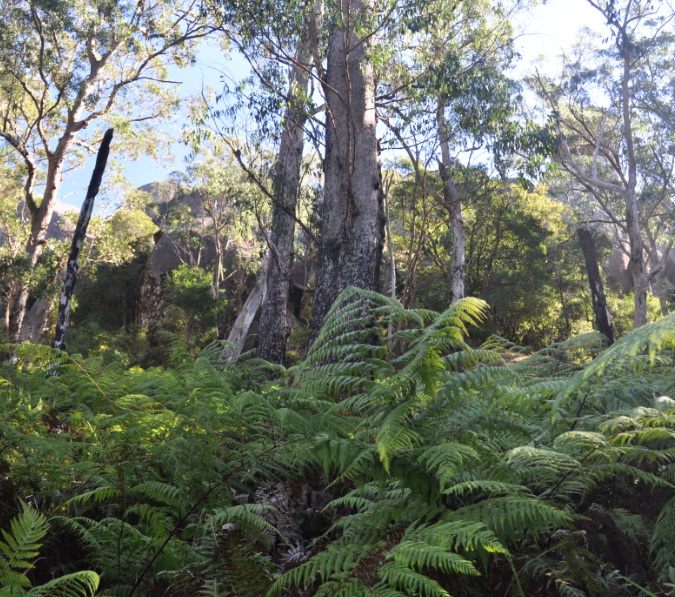
In June we visited Woolloolni Woolloolni Aboriginal Place in Basket Swamp National Park and walked to an outcrop of huge granite boulders – a sacred site. This experience taught me a number of lessons about broadening my view.


It is worth seeking directions

We had visited this National Park last year, but failed to locate this Aboriginal Place, based on our limited directions. However this time we visited the Tenterfield Visitor’s Information Centre beforehand, and found an information sheet that both enriched our experience and led us to our destination.

Life is like this too – sometimes we can get away with flying blind, but often having more information can broaden both our viewpoints and our life experiences.


Look up, not just down


We followed an overgrown track to a granite outcrop, which we were unable to see through the dense forest from the carpark, and whilst concentrating on searching for the walking track. The track required careful placement of our feet, and we were unable to see the outcrop until we were nearly upon it. Ferns and other native vegetation brushed our legs as we walked.. However, after we had bush-bashed our way back to the car park, I looked back over towards the outcrop and could now see it through the trees as I looked up.

And I realised that we can miss things on our life journeys if we only look down, seeking the track or the next place to step. Lifting our gaze can also change our mood.


Enjoy the richness of complexities

The sacred site was a large balancing rock dominating the outcrop, and this had been given different names by European and Aboriginal peoples. Hewitt, when exploring in 1840/41, had simply named it Wellington’s Lookout because he thought that it resembled the hat worn by Wellington at the Battle of Waterloo (a quick European interpretation and naming).

By contrast the Aboriginal people have woven much more complicated and meaningful legends around it, which relate to its formation and significance to the landscape. Their creation story believes that Woollool Woollool (a Wuyangali, or “clever man”) had exclusive rights to this rock, a centre of spiritual power, but when he died his spirit returned to this place and caused a rock on top of the present balancing rock to fall off. This indicated that his spirit had returned, and it would now be safe for anyone to approach the site. (Reference: Tenterfield and District Visitor’s Association Information Sheet: Woollool Woolloolni).

Seeking deeper meanings can also broaden our perspectives. 


Look from a different perspective

On our way out of this area, we detoured up Timbarra Trig Road, parked on the edge of a hill, and walked a short distance up to another outcrop of granite, where we scrambled between boulders and onto rock platforms for extensive views over Tenterfield and the ranges beyond. To the east we could clearly see the Woollool Woolloolni outcrop, rising above the skirt of its vegetation.


Sometimes in life too, it is helpful to move away from closeness to issues and challenges and view them from a distance and/ or see them in their broader surroundings. 


Remember: If you don't like where you are, just picture where you want to be. (From "Touched by an Angel TV series).


Thursday, 30 August 2018

"Victim" and "Survivor" as Labels

In her book Beyond Survival: Living Well is the Best Revenge, Yvonne Dolan talks about stages in healing from abuse, the first being as a "Victim", the second as a "Survivor", and the third "Being your Authentic Self". She points out that people who have experienced abuse can become stuck when they label themselves as "Victim" and "Survivor", and encourages them to keep moving on into the third stage, so that life can be lived and enjoyed more fully.

This is not to say that being a victim or survivor is not valid, but it is better not to use these as labels that stick. She names tasks that need to occur in each of the three stages.


Victim Stage

Tasks in this stage include:
  • facing the reality of the bad things that have happened
  • tapping into feelings that go with this and letting out (expressing) these feelings
  • knowing that it is not your fault (let go of self-blame and shame)
  • finding the courage to tell someone else what happened (to overcome isolation, fear and shame)


Survivor Stage

Tasks include:
  • beginning to see that the bad things are in the past and that you have lived beyond them
  • asking yourself "how did I do this?" and "how was I able to survive this?"
  • identifying the things that allowed you to survive, including internal strengths, external resources, positive personality characteristics (these may have already existed before the trauma, or been developed after it)
  • being able to function productively again in everyday life


Being your Authentic Self

Our Authentic Self is a Sanctuary deep within us where we can heal our wounds, delight in being alive and feel safe and solid in the storms of life.
Tasks include:
  • seeing survivor-hood as a significant aspect of self but not your total self, and celebrating it
  • stopping seeing life through the window of survivor-hood
  • giving up the labels of "Victim" and "Survivor"
  • creating a rewarding and satisfying life for yourself now
  • beginning to live according to the person you really are deep inside
  • having hopes and dreams becoming stronger than past expereinces
  • enjoying life to the fullest
  • reaching towards your potential
  • expressing yourself in personally and rewarding creative ways
  • expressing all the gifts you were born with
  • trusting your own knowledge and abilities
  • feeling more secure with yourself
  • being less willing to squander your time and energy on relationships or situations that are abusive or toxic for you


Healing is not linear

Whilst it may be helpful to talk about stages of healing, in fact, healing from abuse does not occur in neat stages, and we may find ourselves oscillating between them. Things like guilt, unhelpful comments from others, triggers and reminders, and needing to go back into survival mode where we need to keep our guard up, may send us temporarily back into victim mode, even although we have moved on. However re-labelling ourselves as a "Victim" is unhelpful and limiting.

Similarly, aspects of our authentic selves may be present in other areas of our lives even when we are engaged in victim or survivor related tasks. This may be e.g. when we are able to laugh at ourselves and our mistakes, when we have the courage to leave uncomfortable situations, and/ or when we trust in ourselves and our abilities.


A great resource

Yvonne's book is currently available as One Small Step: Moving Beyond Trauma and Therapy to a Life of Joy:

https://www.booktopia.com.au/one-small-step-yvonne-m-dolan/prod9780595125357.html

It is full of exercises to help us connect with our authentic selves.

Remember: I survived what happened to me but its not who I am now. 

It's part of me but not all of who I am.


Thursday, 23 August 2018

Labels

Assigning labels to people can dehumanise them (we are all more complex than this and need to be seen in the context of our life stories). Labels can create barriers and exclusions.


Diagnostic labels

Lucy Maddox in her book "Blueprint: how our childhood makes us who we are" describes diagnosis as a blunt old tool for describing the subtleties of what is happening for someone and says that it is highly subjective, pointing out that even  DSM lists are debated in meetings by Psychiatrists. She further says that it is more useful to see things like depression and psychosis as spectrums or continuums with degrees of intensity of e.g. sadness or hearing voices, and whether or not they interfere with a person's functioning.

She writes that although labels can be powerful as levers for extra support they also remain powerful in their capacity to stigmatise and shame and are very difficult to remove once they are assigned.

More information on her book can be found here:


Pervasive Labelling Disorder

David Levy has written a tongue-in-cheek article about those who are addicted to labelling others, and this can be found at:


Labelling theory

Labelling theory arises from Sociology and proposes that people will behave in accordance with how others label them. It arose in the 1960s and 1970s, and key theorists were Emile Durkheim, George Herbert Mead and Howard Becker. There was a particular focus on crime and deviance, and they theorised that once a person is labelled deviant, they are likely to see themselves as deviant and act accordingly.

A good overview of this theory can be found on this YouTube clip: 

https://www.youtube.com/watch?v=do6_KgRslDc


Self-labels

Sabine Beecher in her book "Happiness it's up to you" talks about self labels being illogical, self-destructive and all-pervasive. She says that calling ourselves names e.g. "failure" or "stupid" can make us feel that the whole of us is a "failure" or "stupid", that we will be like this forever and that there is no way out. She also points out that,conversely, labels cannot turn us into that label and uses the example that quacking like a duck does not turn us into a duck. 

She sees labels as opinions not facts and that they are usually about one thing we have done -- they are not about us as a whole person, and to free ourselves up from them we need to turn them into facts i.e. say exactly what happened -- no more and no less. She suggests doing an exercise where we write down the labels we use on ourselves, change these to straight facts and then write what we are going to do about the fact (e.g. the label "stupid" might have been applied after the fact "I spilt the milk" and what we are going to do is to "wipe it up and be more careful in future").

Further, she points out that good labels can be just as destructive as bad, as they can make us go up and down on the scales of worth, leaving us feeling insecure and anxious, and we need instead to aim for self-acceptance. She says that others can put labels on us too, but these will only hurt if we turn them into self-labels and, with these labels we can seek their real meaning (e.g. someone labelling us as "too sensitive" may really mean "I can't handle your feelings").

Her excellent book used to be able to be obtained from her website (however I got a message saying it was closed for maintenance when I tried today):

Sabine Beecher Happiness it's up to you:easy steps to self-acceptance and good relationships Boolarong Press, Australia, 2008 (reprint) ISBN 0 646 33230 9.


Remember: labels are judgements

Authenticity is the daily practice of letting go of who we think we are supposed to be, and embracing who we are.  Brene Brown (berryintention.com)


Wednesday, 15 August 2018

Shame: the hidden emotion

Shame may often be hidden behind other emotions like anger, depression, anxiety and/or low self-worth. It is an emotion that thrives on secrecy.


What is shame

Adi Jaffe defines shame as "the feeling that there's something wrong with you. It's not about having done something wrong (that's guilt), no, shame arises from the core belief that you are simply not good enough". (Adi Jaffe How to overcome shame and build self-confidence)

Gershen Kaufman writes that "shame is the most disturbing experience individuals ever have about themselves; no other emotion feels more deeply disturbing because in the moment of shame the self feels wounded from within". (Jane Bolton What we get wrong about shame)


The difference between guilt and shame

A very useful table outlining the differences can be found at:

What causes it

Shame is often the result of being harmed (physically or emotionally) by someone else (especially as a child, a time when we are most vulnerable), or going through traumatic experiences where we felt threatened. Sometimes we may have taken on the shame of the person who has mistreated us, even although we did not cause this mistreatment. We may have been told to blame ourselves for abuse or think that we should have done something to prevent or stop it, even although it was not our fault and we did not have the power to protect ourselves. Our sense of self may have been attacked or we may have been given negative messages about ourselves, even although this was more about the inadequacy if the other person.

We may feel ashamed of not being able to overcome problems and needing to reach out for help, although there is nothing shameful about our pain and reactions. If we've been shamed as a child and been given negative messages about ourselves, then this may be how we see ourselves now.


The shame continuum

Shame can range in intensity from fleeting feelings of embarrassment all the way up to chronic humiliation, where we feel flawed and inferior as a whole person. It may be related to one event or only one area of our lives, or may be more pervasive.

       l__________________________________________________________l
Embarrassment                                                                                   Chronic humiliation


How to overcome shame

Firstly we need to recognise and externalise the shame and its sources, by finding the courage to be open and honest about it and the influence that it has had on our lives (including the messages and self-labels that we carry as a result).

Then we need to seek and listen to other more helpful voices that give us positive messages about ourselves and allow these, and other strategies,  to grow self-acceptance. We may need to seek and accept help from others if this is too difficult for us.

An excellent program based on Shame-resilience can be found at:

Today I will learn to reject shame. Shame is an overwhelming sense that who I am is not good enough. I realise that I am good enough and that my imperfections are part of being human. I let go of shame. www.thoughtsfornow.com 

If we share our story with someone who responds with empathy and understanding shame can't survive. Brene Brown