Thursday, 15 October 2020

When it is difficult to feel gratitude: look for protection and provision

 I keep a gratitude journal, which I write in at the end of each day. However on some days it is a struggle to find things to be grateful for, and then I find that it helps to look for examples of protection and provision instead. It seems to be that gratitude is linked with a sense of happiness and positivity -- and some days it can be difficult to feel this -- whereas protection and provision is more feeling neutral.

23rd Psalm 

At the beginning of the pandemic I found lots of comfort in the 23rd Psalm and, as I read it, it occurred to me that it was all about protection and provision, the two things that I most needed.

The Lord is my Shepherd, (a Shepherd protects the sheep)
I shall not be in want. (promise of provision)
He makes me lie down in green pastures,
He leads me beside quiet waters, 
He restores my soul. (protection and provision)
He guides me in the paths of righteousness,
for His name's sake. (provision)
Even though I walk
through the valley of the shadow of death,
I will fear no evil,
for You are with me; (protection)
Your rod and your staff, they comfort me. (protection and provision)

You prepare a table before me
in the presence of my enemies. (protection and provision)
You anoint my head with oil;
my cup overflows. (provision)

Surely goodness and love will follow me
all the days of my life,
and I will dwell in the house of the Lord forever. (the ultimate protection and provision)

(NIV version of the Bible).


Protection

I found that by living life one day at a time, some days I know I am in a totally safe place at home, and I just need to remind myself of this when fears and anxieties creep in. However on days when I need to venture forth into the wider world, I might reflect that I was protected by e.g. shopping in an uncrowded supermarket, finding no-one else in the waiting room when I needed to go for pathology tests, people around me maintaining physical distancing in the pharmacy, and others wearing masks (a bit of a rare occurrence in our town, sadly) etc.


Provision

During the year, I have found abundant examples of this, ranging from the breaking of the drought (and our green pastures in which to rest), to vegetables and herbs growing in my garden, to finding scarce groceries in the supermarket, to having a storehouse of fabrics and sewing supplies and other resources to draw on, to finding on-line inspiring courses, to beautiful places to walk on our farm, to encouraging emails from friends and relatives, to comforting music, to living in Australia -- and so much more.

I have noticed that if I use the heading "Provision" in my gratitude journal on days when I am not feeling very grateful, I end up writing many things that I may have written as things to be grateful for on a better day.


Remember: Real empathy is sometimes not insisting that it will all be OK, but acknowledging that it is not. Sheryl Sandberg.


Tuesday, 6 October 2020

Covid 19: The many shades of grey

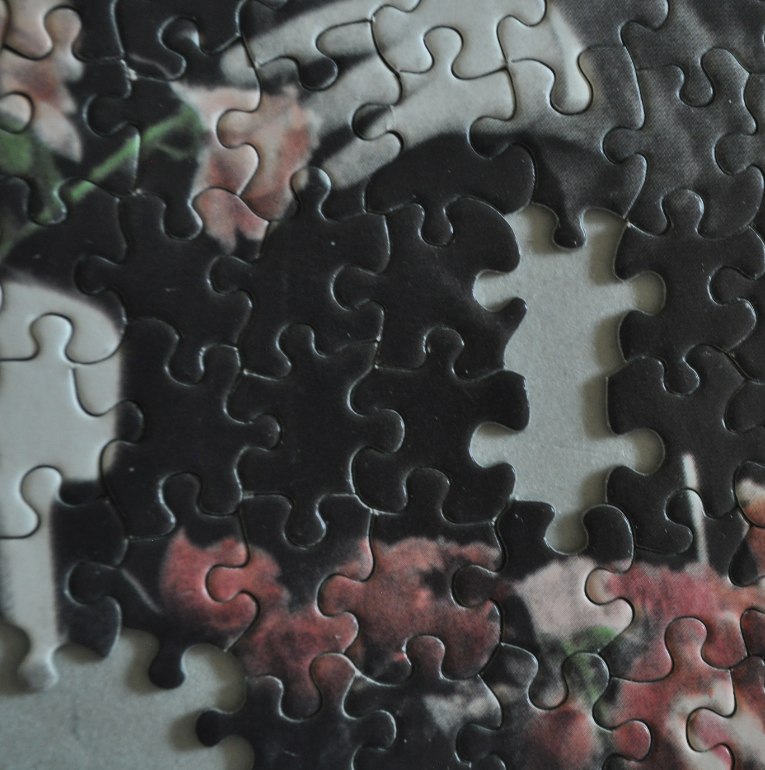
 As we navigate through this strange year where we cannot predict what tomorrow will bring, it occurs to me that we are living with shades of grey, when we would be more comfortable with black and white answers. Putting together a mostly black, white and shades of grey jigsaw had me reflecting on this as a metaphor for this year.

Black and white is easier to see

Just as the black and white pieces tend to stand out from the grey ones in the puzzle, so do the black and white facts about this Virus. However even some of the black and white puzzle pieces still have tinges of grey, and so does the Virus -- some of the seeming facts change as more is learnt and we are given new advice (in Australia this occurred with the wearing of masks).


Sometimes it helps to focus on small details

When it all becomes too much, honing in on putting together a smaller detail can help in struggling with the puzzle. This can help too when we feel overwhelmed with the magnitude of the Virus -- some days we need to just live in our safe bubble and concentrate on doing the things we can do.


Sometimes we need to seek order in overwhelming chaos

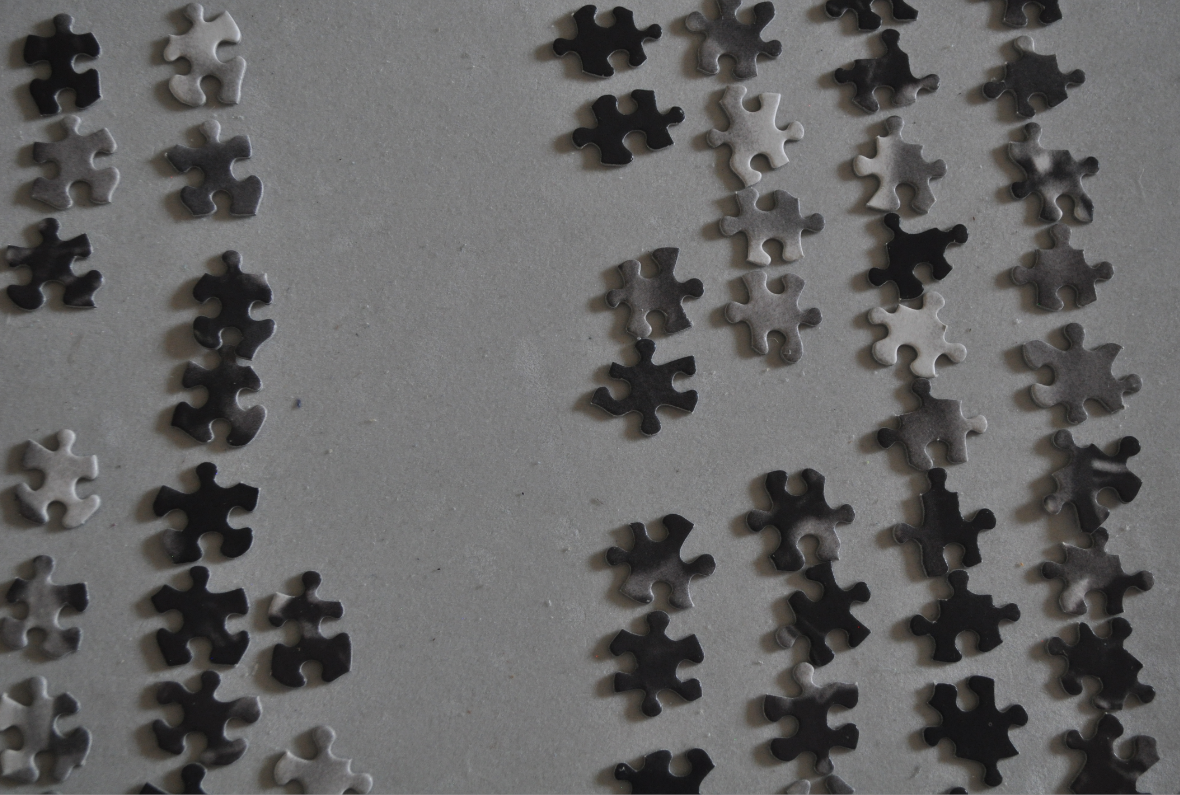
At one stage of my struggle to put the puzzle together, I chose to line up rows of similarly shaped pieces to make them easier to find. We can create some order in our daily lives too, so that we are not completely surrounded by chaos.


Looking for colour

This particular puzzle had a band of coloured roses across the middle, to contrast with the shades of grey, and in our current world it helps to look for colour in the things we can still be grateful for (especially protection and provision, which I plan to make the subject of a separate post).


We may struggle to find some pieces

As the jigsaw puzzle progressed I struggled to find some particular pieces (even though they were there), and there are still many things about this Virus that are a struggle to understand or make sense of in the overwhelm of information available to us.


There are missing pieces

Even when I finally finished the jigsaw, I discovered that one piece was missing. In relation to the virus there are still quite a number of missing pieces and we do not know what tomorrow, next week or next year will look like.


Remember: Let difficulty transform you. And it will. In my experience, we just need help in learning how not to run away. Pema Chodron.


Thursday, 10 September 2020

Navigating the confusing world of home made masks

 There are now so many patterns and choices out there for masks, that it becomes quite confusing trying to decide which ones are best. I eventually settled on one from ithinksew as it fitted well and comfortably, gave an extra seal at the top with its unique design, had a pocket for a filter (so three layers), had adjustable ear elastic, and did not have a front seam (which could potentially allow leakage through the sewing lines).

Here is a link to the free pattern I chose:

Mask pattern

It includes a video tutorial, but no written instructions, so I have outlined the process below.


Cut out the pattern pieces -- an outer piece from tightly woven quilting cotton, and two inner pieces from a soft knit fabric (for comfort).


Join the two inner pieces together along the straight edges, leaving a 4 inch (10 cms) gap in the middle (this will be where the filter is inserted when the mask is finished).


Top stitch along both sides of the seam.


Sew the darts together on each of the pieces.


With right sides together, sew around the whole mask, then clip the corners and curves.


Turn right side out through the gap on the inside (the filter insertion gap) and iron.


Cut some wire about 4-5 inches long (10 -13 cms) for the nose area. I used a pipe cleaner as it moulds well around my nose, but I cut it 5-6 inches (13- 15 cms) long and twisted the ends in, so that there were no sharp ends to poke through the fabric. 

Then sew a casing at the top of the mask, the length of the wire, leaving one end open (unsewn).


Thread the wire into the casing and then sew the open end closed. I added some more stitching lines through the wire, a little in from each end, to hold the wire in place (it can tend to bunch up otherwise).


Cut two pieces of 3mm wide elastic, with each about  9 inches (23 cms) long (or maybe a little longer for a male), and thread a pony bead to the middle of each one. Then thread the two ends of the elastic onto a tapestry or darning needle and pull it through a bead with a slightly smaller hole. I used some blunt nosed jewellery pliers to assist with pulling. The hole in the pony bead is too big to hold the elastic secure when fitted around the ear, but is fine for the outer bead.


This is how it should look when completed.


Take one of the pieces of beaded elastic and lay one half of it it in the middle of a side flap, then fold the flap over and sew it down with the elastic inside. Knot the ends together and pull the knot inside the casing. Repeat on the other side of the mask.


Fold down the top of the mask, level with the tops of the side elastic casings, and top stitch right across.


Fold each side flap down to meet the edges of the elastic casings and sew down.


Insert the filter. A template is provided with the pattern. I have used Matilda's Own DIY Non-Woven Mask Filter inserts which come in a packet of A4 sized sheets. Filters can also be made from denim, layers of paper towel, and non-woven interfacing.

For my 95 year old mother, I sewed the denim directly to the inside of the backing fabric and cut the backing in one piece. Then I left one of the sides open where the elastic goes, so that it could be turned right side out and then closed when the casing was sewn down.


Remember: Sometimes you just need to relax and remind yourself that you're doing the best you can and everything is going to turn out just fine. Gratitude App.


And don't forget to wear your mask. It is a great way to encourage others to do so too, and to remind them to practice social distancing in the supermarket!


This is the view from our front verandah now -- very different to this time last year!


Monday, 15 June 2020

Bag of the month: Pinwheel bag

This is the bag I made in May -- an easy to sew and versatile, adaptable pattern that produces a bag that could be used for multiple purposes, including as a gift bag.


Basic bag

This particular version has cords drawn through a bead to close the top, and I found the pattern and tutorial here: little bag tutorial

The only pattern piece that you need will end up looking like this:


I call these bags pinwheel bags because the bases end up looking like this:


Embroidered version

I thought this would make a nice gift bag for some pampering products. The embroidery design was from Jenny of Elefantz blog and was offered earlier this year, although is no longer available. However she has many other designs, which can be found here: Jenny of ELEFANTZ blog


Add a pocket

To add a pocket cut another pattern piece , but with sides only 6 inches long. Overlock the top edge and then fold it down 1.5 inches and sew it down. Lace can be added to cover the stitching line. Then baste the pocket to the side it will go on, before sewing the bag together. The pocket piece will include the triangle of the base. It is nice to add  pockets to two opposite sides, and one could be used to hold a card, if the bag is used for a gift.


Make a draw string top instead

The original bag was designed with a draw-string top, and the pattern shape can be made in any size that suits the purpose. Instructions for this version can be found on this blog, titled "Saving our planet: making a bag for rags" under the "Saving our planet" tag. 


Remember: Happiness comes from living as you need to, as you want to. As your inner voice tells you to. Happiness comes from being who you are instead of who you think you are supposed to be. Shonda Rhimes.


Tuesday, 26 May 2020

Walking

I have been doing lots of walking over the past few months -- both for exercise and for my mental well-being, especially in these challenging times. Lately I have been musing that we can walk in various ways to fulfil various purposes.


Ruminating

Walking is a good thing to do when we are bogged down in thoughts that keep dragging us down (or in whirlpool thoughts that keep sucking us down deeper and deeper). I have noticed that, when I walk, thoughts tend to just flit in and out of my mind instead, and this is much more freeing. When walking in this fashion I tend to find myself turning inwards and not really taking in my surroundings, but I do tend to return home with a clearer head.


Processing

Similar to ruminating, this kind of walking goes one step further and leaves us thinking things through more, making connections, problem solving and maybe finding new perspectives. Once again it is an inward looking process, that leaves us largely tuning out to the environment around us.


Engaging in mindfulness

This kind of walking has us looking outwards and taking in our surroundings with all our senses. It is about living in the here and now, looking more deeply into our environment and noticing smaller details, and it gives our minds a break from ruminating and processing.


Turning on creativity 

Moving through different outdoor spaces can provide inspiration for writing, art works, sewing, metaphors and other creative pursuits. The idea for this blog post came to me whilst I was walking.


Gratitude creating

Often whilst walking we notice things that we can be grateful for, like flowers, trees, gardens, clear skies, a friendly smile, cute dogs, care-free children, and many other things.  Walking also gives us a chance to think of other things, not immediately seen, for which we can be grateful.


Exercising

This is the obvious purpose, but I have left it until last for that reason. I have noticed however, that when I am walking for this purpose, my pace is faster and I am usually looking down at the ground and concentrating on where I place my feet (I walk on dirt roads). This gives me both a limited view and purpose. Food for thought!


Remember: Don't quit yet, the worst moments are usually followed by the most beautiful silver linings. You just have to stay strong, remember to keep your head up and remain hopeful. Gratitude App


Thursday, 14 May 2020

Setting up a mobile hand washing station

When out and about it is much more convenient to use appropriate hand sanitizer containing 60 % alcohol (which kills viruses and not just bacteria). However, if you are like me and your hands react to the sanitizer, you might like to use this alternative.


This may be a better option anyway

With the shortage of hand sanitizer continuing, and with the assurance that proper hand washing with soap is preferable in protecting ourselves from the Covid 19 virus, this is a way of not having to rely on hand sanitizer when we are out. However it does depend on having a vehicle to access every time we need to wash our hands.


What to use

After a lot of thought I chose to recycle two honey tubs, use a shallow plastic take-away container for the soap (homemade), and include a larger bucket for spare water. Ice-cream tubs could also be used, but any container will need to have a lid. I had originally intended to include a reusable hand towel, but then decided that a couple of washers would work just as well, and allow for not reusing the same towel on an individual trip to town. All of this is placed in a plastic crate, and water is added to the "dirty" and "clean" containers before we leave home (they only need to be half filled).


How to use

Before leaving our vehicle to shop, I set up the station on the back seat by removing the lids from the "dirty" and "clean" containers (suitably labelled with a permanent marker for ongoing use) and the soap container, and ensure that the washer is easy to reach. I leave all of this in the plastic crate.

After shopping I dip my hands in the "dirty" container to wet them, then lather with soap and do the proper 20 second hand washing routine, before rinsing them off in the "clean" tub. Then my hands can be dried with the washer.

The lids are then carefully replaced on the containers, ensuring that my hands do not touch any part of the "dirty" tub that could have been contaminated by my unwashed hands. As long as hands are dipped straight into the water, this should not be a problem.


For multiple uses

One trip to town just to get groceries will only require one wash. However if we need to go to multiple places I then carefully empty the "dirty" water and refill this container with water from the spare supply. I find that having the handle on the tub makes this task easier. Then it is just a matter of proceeding as above (but maybe choosing to use a new washer).


After returning home

Water from the "dirty" and "clean" tubs will need to be emptied and the containers washed and dried. The used washers are also laundered. I leave the spare tub of water as is, if none has been used, but top it up otherwise.


Remember: instead of worrying about what you cannot control, shift your energy to what you can create. Roy T. Bennett