Monday, 15 June 2020

Bag of the month: Pinwheel bag

This is the bag I made in May -- an easy to sew and versatile, adaptable pattern that produces a bag that could be used for multiple purposes, including as a gift bag.


Basic bag

This particular version has cords drawn through a bead to close the top, and I found the pattern and tutorial here: little bag tutorial

The only pattern piece that you need will end up looking like this:


I call these bags pinwheel bags because the bases end up looking like this:


Embroidered version

I thought this would make a nice gift bag for some pampering products. The embroidery design was from Jenny of Elefantz blog and was offered earlier this year, although is no longer available. However she has many other designs, which can be found here: Jenny of ELEFANTZ blog


Add a pocket

To add a pocket cut another pattern piece , but with sides only 6 inches long. Overlock the top edge and then fold it down 1.5 inches and sew it down. Lace can be added to cover the stitching line. Then baste the pocket to the side it will go on, before sewing the bag together. The pocket piece will include the triangle of the base. It is nice to add  pockets to two opposite sides, and one could be used to hold a card, if the bag is used for a gift.


Make a draw string top instead

The original bag was designed with a draw-string top, and the pattern shape can be made in any size that suits the purpose. Instructions for this version can be found on this blog, titled "Saving our planet: making a bag for rags" under the "Saving our planet" tag. 


Remember: Happiness comes from living as you need to, as you want to. As your inner voice tells you to. Happiness comes from being who you are instead of who you think you are supposed to be. Shonda Rhimes.


Tuesday, 26 May 2020

Walking

I have been doing lots of walking over the past few months -- both for exercise and for my mental well-being, especially in these challenging times. Lately I have been musing that we can walk in various ways to fulfil various purposes.


Ruminating

Walking is a good thing to do when we are bogged down in thoughts that keep dragging us down (or in whirlpool thoughts that keep sucking us down deeper and deeper). I have noticed that, when I walk, thoughts tend to just flit in and out of my mind instead, and this is much more freeing. When walking in this fashion I tend to find myself turning inwards and not really taking in my surroundings, but I do tend to return home with a clearer head.


Processing

Similar to ruminating, this kind of walking goes one step further and leaves us thinking things through more, making connections, problem solving and maybe finding new perspectives. Once again it is an inward looking process, that leaves us largely tuning out to the environment around us.


Engaging in mindfulness

This kind of walking has us looking outwards and taking in our surroundings with all our senses. It is about living in the here and now, looking more deeply into our environment and noticing smaller details, and it gives our minds a break from ruminating and processing.


Turning on creativity 

Moving through different outdoor spaces can provide inspiration for writing, art works, sewing, metaphors and other creative pursuits. The idea for this blog post came to me whilst I was walking.


Gratitude creating

Often whilst walking we notice things that we can be grateful for, like flowers, trees, gardens, clear skies, a friendly smile, cute dogs, care-free children, and many other things.  Walking also gives us a chance to think of other things, not immediately seen, for which we can be grateful.


Exercising

This is the obvious purpose, but I have left it until last for that reason. I have noticed however, that when I am walking for this purpose, my pace is faster and I am usually looking down at the ground and concentrating on where I place my feet (I walk on dirt roads). This gives me both a limited view and purpose. Food for thought!


Remember: Don't quit yet, the worst moments are usually followed by the most beautiful silver linings. You just have to stay strong, remember to keep your head up and remain hopeful. Gratitude App


Thursday, 14 May 2020

Setting up a mobile hand washing station

When out and about it is much more convenient to use appropriate hand sanitizer containing 60 % alcohol (which kills viruses and not just bacteria). However, if you are like me and your hands react to the sanitizer, you might like to use this alternative.


This may be a better option anyway

With the shortage of hand sanitizer continuing, and with the assurance that proper hand washing with soap is preferable in protecting ourselves from the Covid 19 virus, this is a way of not having to rely on hand sanitizer when we are out. However it does depend on having a vehicle to access every time we need to wash our hands.


What to use

After a lot of thought I chose to recycle two honey tubs, use a shallow plastic take-away container for the soap (homemade), and include a larger bucket for spare water. Ice-cream tubs could also be used, but any container will need to have a lid. I had originally intended to include a reusable hand towel, but then decided that a couple of washers would work just as well, and allow for not reusing the same towel on an individual trip to town. All of this is placed in a plastic crate, and water is added to the "dirty" and "clean" containers before we leave home (they only need to be half filled).


How to use

Before leaving our vehicle to shop, I set up the station on the back seat by removing the lids from the "dirty" and "clean" containers (suitably labelled with a permanent marker for ongoing use) and the soap container, and ensure that the washer is easy to reach. I leave all of this in the plastic crate.

After shopping I dip my hands in the "dirty" container to wet them, then lather with soap and do the proper 20 second hand washing routine, before rinsing them off in the "clean" tub. Then my hands can be dried with the washer.

The lids are then carefully replaced on the containers, ensuring that my hands do not touch any part of the "dirty" tub that could have been contaminated by my unwashed hands. As long as hands are dipped straight into the water, this should not be a problem.


For multiple uses

One trip to town just to get groceries will only require one wash. However if we need to go to multiple places I then carefully empty the "dirty" water and refill this container with water from the spare supply. I find that having the handle on the tub makes this task easier. Then it is just a matter of proceeding as above (but maybe choosing to use a new washer).


After returning home

Water from the "dirty" and "clean" tubs will need to be emptied and the containers washed and dried. The used washers are also laundered. I leave the spare tub of water as is, if none has been used, but top it up otherwise.


Remember: instead of worrying about what you cannot control, shift your energy to what you can create. Roy T. Bennett


Friday, 8 May 2020

Managing food supplies

Who would have thought that this would become an issue in Australia? When I first saw certain sections of supermarkets with empty shelves I felt quite shocked, and slowly realised that I would need to plan more carefully. I know that some people had previously been into pantry preparedness and could now gently remind us that they had "told us so". However I was not one of them, and being super organised was not for me. So this is how I have managed.


Taking inventory of existing supplies.

As I live out of town on a rural property, I have never been able to just pop down to the shops when I needed something, so I have managed by trying to ensure that, with basic supplies, I always had one spare. I would then buy that item again when I opened the spare packet.


Now, however, I could no longer ensure that things would be available when I needed them. Thus, after the initial feeling of panic settled, I took a notebook and went through my pantry, fridge and freezer and wrote down every item I had, and how much of every item I had. I then added a column to plan extras to buy if needed, so that I could build up supplies of at least two spares, instead of just one. This then informed my shopping list.

I am aware that some people are unable to afford to purchase extras, but by using this approach they may be able to gradually build up some spares by buying just one or two extras at a time.


Taking inventory at the supermarket.

The next step was to take note of the things in short supply at the supermarket and accept that my extras may need to be acquired over time (which turned out to be correct). Sometimes this meant finding substitutes (e.g. there was still couscous on the shelf even although all the rice and pasta had gone). 


Opportunistic shopping

I usually shop to a shopping list, but now found that it was wise to purchase difficult to find items when I came across them. For instance, when toilet paper was in short supply, there were times when a shop assistant would walk around offering packets so, of course that was the time to gratefully accept one. 

Another time I was in the Pharmacy getting prescriptions filled, and noticed a whole table of 500 ml hand sanitiser near the front counter, and naturally added one to my shopping (having seen none anywhere else for weeks). It was $15 a bottle, which I considered to be quite expensive. However after I returned home I found the same sanitiser on line for $36 a bottle!


Doing it differently to usual

Whilst frozen vegetables and some tinned items have sometimes been in short supply, this has rarely been the case with fresh fruit and vegetables. As a result I have chosen to buy  extra fresh fruit and vegetables and then cut them up, blanch and freeze them. The bonus is that these are usually grown in Australia. One pineapple will give me the equivalent of 4 tins of pineapple, a 1 kg bag of tomatoes taken home and cut up and stewed also yields the equivalent of about 4 tins of tomatoes. One bunch of celery chops up into lots of frozen celery pieces and the leaves can be used in making stock and soup. 


Remember: Nature provides us with food too.


Monday, 27 April 2020

Reusable bag of the month: strawberry bag

I have certainly gotten behind with posting these! For my second bag I chose to make a Strawberry Bag that folds into triangular pockets. I began with a pattern downloaded from craftpassion.com, but altered it to attach handles separately, as I experienced a lot of frustration in trying to sew bias tape around the handles in the original pattern, and the triangle pocket was too small. The original pattern can be found here:
Strawberry bag pattern and tutorial

This is how I made my version.


Cutting out the pieces

For the main bag you will need to cut two pieces 14.5 inches wide x 15 inches long (37 cms x 38 cms). For the handles cut two pieces 2.5 inches wide x 16.5 inches long (6 cms x 42 cms). For the casings cut two pieces 7.5 inches x 2 inches (19 cm x 5 cms). From contrasting fabric cut one 7 inch (18 cms) square and then cut this in half diagonally to make two triangles for the pockets.


Make the pocket

Turn the ends of each casing piece in 1/4 inch and sew them down.


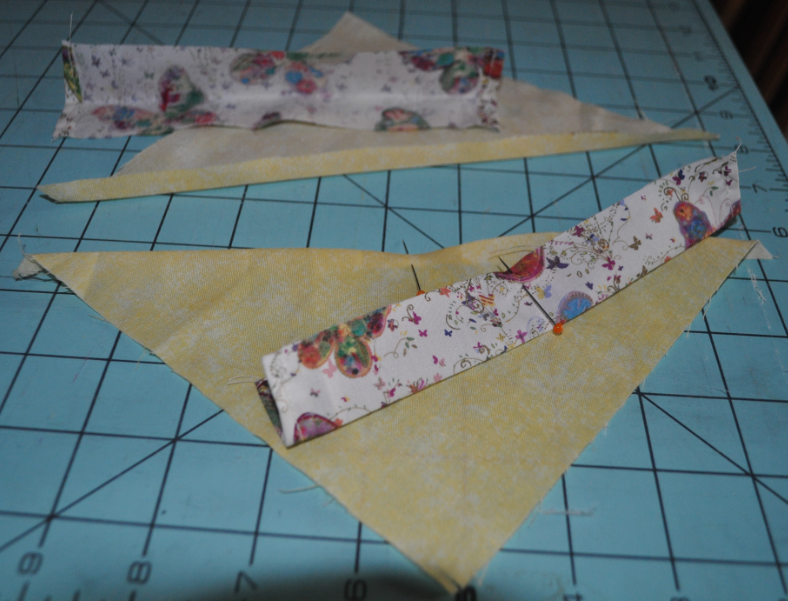
Fold them in half and mark the middle with a pin. Fold the longest side of the triangle down 1/4 inch and iron. Then mark the middle of this with a pin. Pin the casing to the long side of the triangle, matching the centre pins.


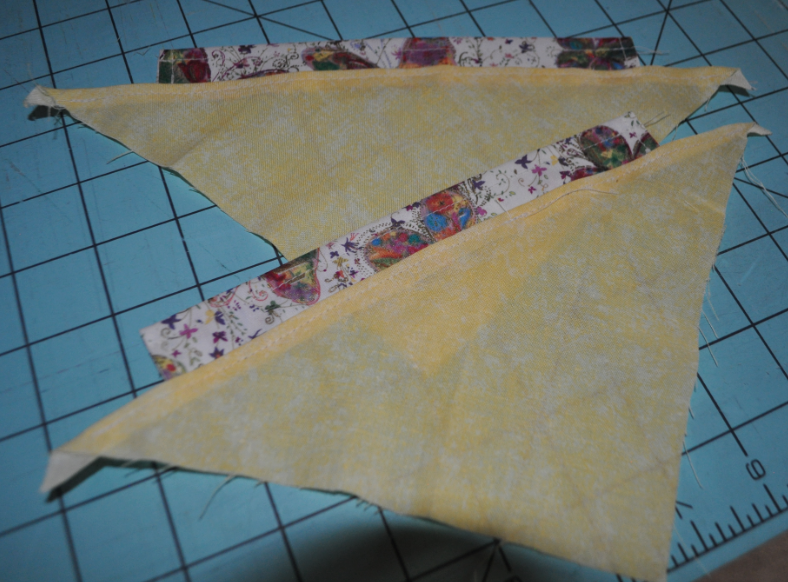
Sew them together, then sew a line along the casing 1/4 inch from the top.


Sew the bag together

Pin the pockets to the bottom corners of the bag pieces, wrong sides together, making sure that each is on an opposite corner, so that they will meet when you sew the bag sides together. Baste them to the bag close to the bottom and side edges.


Then, right side together, sew the sides and the bottom of the bag together. Overlock the seams to neaten if you like.


Make the handles

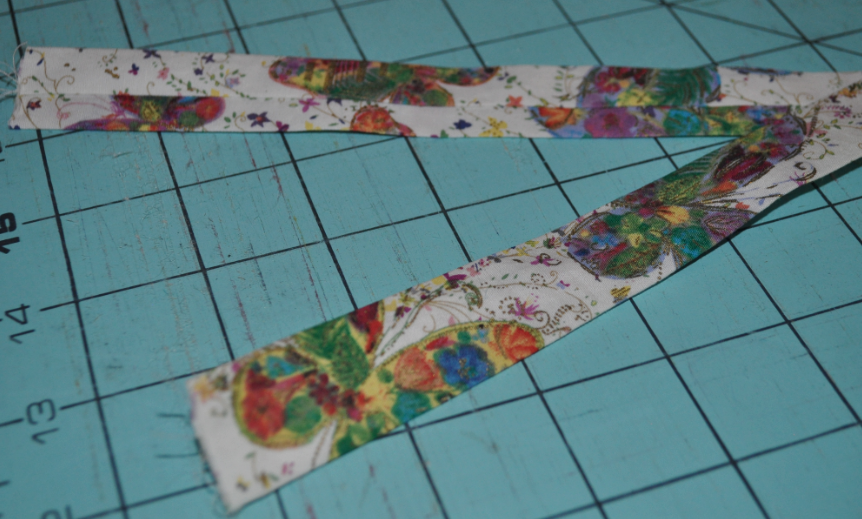
Right sides together, fold each handle in half and sew along the long sides.


Turn right side out and iron, so that the seam is in the centre of each handle.


Attach the handles to the bag

Pin the handles to the top of each side of the bag, with each end 3 inches (8 cm) from the side seams. Make sure the handle seam is facing up. Baste the handles to the bag.


Turn the top of the bag over 1/4 inch, including the handles if the turn.


Then turn over again to make a hem and pin and sew around the top.


Finishing off and folding the bag into the pocket

Thread a 25 inch (64 cms) long cord through the casing on the pocket, taking it all the way around both sides of the pocket, then tie the ends together with a knot.


To fold the bag into its pocket, you could simply stuff it in, but I folded the sides in and then rolled it into the pocket.


Pull up the cord, and now we're done!


Remember: Build someone up. Put their insecurities to sleep. Remind them they're worthy. Tell them they're magical. Be a light in a too often dim world. Gratitude App.


Friday, 24 April 2020

Connecting with grandchildren

One of the saddest things I am finding for me during this time of social distancing is being physically cut off from my grandchildren. I know that Skype, Duo, Signal etc allow us to communicate electronically, but I realised that I needed more, and came up with the idea of sending daily episodes of a story about a doll, Marilyn (that used to belong to my daughter) that my 2 yr old granddaughter fell in love with at Christmas time (but then thankfully chose to leave at Gran's house). Any toy loved by your grandchild would do.


This has had added bonuses, like being able to send messages to my daughter daily when I attach Marilyn's next adventure, keeping my creative brain functioning, giving me something positive to do/ think about every day and creating a lovely connection between myself and my granddaughter (she asks to see Marilyn when we have Duo sessions).


Marilyn helps me with daily tasks and sometimes goes out with Pa to do farm activities -- all I need to remember to do is to photograph her helping with a task, and then create a simple story around this. I often try to include a photo of my granddaughter doing something similar at the end of each episode. The episodes range from 4 to 6 pages.  Here are some themes:

Cooking

There is a lot of mileage in this one, and I have photographed her helping me to make dishes for dinner, hot cross buns and Easter eggs, chai latte mix, a tart etc, and have plans to have her help me make yogurt, bread and anything else I decide to cook.


Gardening

Once again, there are lots of opportunities here, from sowing seeds, checking seedlings, weeding, harvesting vegetables, fertilising beds, to adding mulch. 


Household chores

What a way to make vacuuming, washing, washing up and dusting etc more interesting and enjoyable!


Sewing

Marilyn has helped me with both hand and machine sewing.


Playing with toys

I began with Marilyn playing with some of the toys that my granddaughter has loved when she has visited us, but then included her in the making of new toys and, in particular, a mouse house with car, furniture and a mouse family that I will eventually give to my granddaughter for her birthday.


Farm tasks

It was important to include Pa in the stories too, and to have Marilyn doing some of the things that my granddaughter enjoyed when she came to stay.


Celebrating special occasions

I will photograph Marilyn with a wooden birthday cake on Sunday to acknowledge my son-in-law's birthday, but so far we have celebrated Easter, and there will be more opportunities to come, like my youngest grandson's first birthday.

A complete story

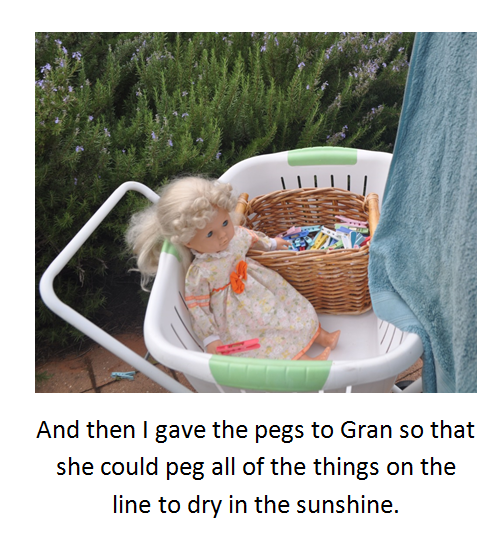
Here is a complete episode, so that this all, hopefully,  makes more sense.


Remember: It's your road, and yours alone, others may walk it with you, but no one can walk it for you. Rumi