Thursday, 30 April 2015

Whirlpool thinking

I have often used the metaphor of a whirlpool when working with clients who present feeling down and consumed with negative thoughts.

The whirlpool metaphor

Whirlpools suck us further and further down as they pull in more and more intrusive thoughts and memories, and they hold us in their power. Then we start digging up dirt from the past to add to our pain. I have found that clients readily relate to this as an apt description of what they are experiencing.

 Of course, once thought processes are described this way, they have been externalised and have lost some of their power. There is a shift from the thoughts controlling them to the client beginning to control their thought processes.


Escaping from the whirlpool

I have found a number of useful tools that can assist in extracting people from whirlpool thoughts, and these include:
  1. Identifying the first thought that led into the whirlpool. This tool comes from the personal experiences of both myself and some of my clients. For some reason, once the first thought is remembered, this particular whirlpool automatically ceases.
  2. Recognising being caught in the whirlpool, and distracting and re-focusing on something more positive.
  3. Going into a state of mindfulness -- connecting with the present and letting go of thoughts about the past and the future.
  4. Thought stopping techniques have been suggested in the past, but here is another opinion on this:
             http://www.anxietycoach.com/thought-stopping.html

      4. Some more ideas can be found on the Positivity Blog here:

http://www.positivityblog.com/index.php/2008/02/11/5-time-tested-techniques-to-control-and-calm-your-mind/


Longer term actions: diving all the way to the bottom

 In her book The Road to Shine Laurie Gardner describes an experience she had when she was training to become a white water rafting guide. She was told to dive into a dangerous keeper hole and that the only way to be released was to dive for the bottom, where the main current stream is located, as this would carry her out of the hole. She then applied this to her life by confronting the things that were holding her back, engaging in a journey of healing, and emerging "downstream" stronger and clearer than before.

This approach  leads to less likelihood of being caught up in whirlpool thoughts. I would also suggest that "diving all the way to the bottom" can be likened to the process of seeking the underlying themes and messages (often from childhood) that tend to drive the whirlpools. Once identified, these messages can be exposed to daylight and challenged.

 Reference: The Road to Shine: a Story of Adventure, Life Lessons, and My Quest for More Laurie Gardner, Central Recovery Press, Las Vegas 2014. I found this book at Booktopia:

http://www.booktopia.com.au/road-to-shine-laurie-gardner/prod9781937612597.html


Monday, 27 April 2015

Psycho-social interventions 2

The previous post focused more on assessment than intervention, so I thought I would expand a little more on intervention.

Psycho interventions (the individual)

It would be very remiss not to provide strategies that may help the client to better manage the symptoms of things like anxiety, depression, grief, overwhelming feelings (including anger and fear), stress, trauma reactions, unhelpful thoughts and unhelpful behaviour. There are a myriad of simple tools that can be provided here and these are readily available on websites targeting anxiety and depression and those providing CBT tools. Some of these have been covered in previous entries on this blog, but other helpful websites include:


Normalising reactions can be a powerful tool to use here too.


Social interventions (the context/ environment)

Sometimes there are fairly immediate and accessible changes that can be made to the client's environment e.g. writing a letter of support for priority housing, referral to organisations that offer emergency relief and/or practical assistance, referral to free legal advice, the provision of accurate information and advocacy to other relevant organisations. I believe that it is important to allow the client to arrange these referrals themselves as much as possible, as this increases their knowledge, skills and autonomy, and their ability to alter their environment.  Once these have been addressed change may continue, or deeper issues may then be able to be worked with.


Interventions targeting the interactions between the individual and their environment

This is where the more complex interventions occur, and these need to be based on good psycho-social assessments. Here we are working with the connections between the client and their environment – the environmental factors that are contributing to their symptoms and the ways they are responding to environmental issues. Some people are more positive and resilient than others, so how one person reacts to an environmental factor (e.g. a motor vehicle accident, the death of a family member or an overcrowded household) will usually differ from how another person will react.
In reality there are usually multiple issues in the environment of the client, and thus multiple impacts on their lives. Identifying links between issues can be useful for both us and the client, and can result in increased insight (hopefully for the client as well as us).

Summing up


Our overall aim is to facilitate change and better functioning for the client. Sometimes these changes are small and sometimes, over time, we are able to encourage more major changes to occur. But remember that it is always up to the client, not us, to implement the changes.

Thursday, 23 April 2015

Psycho-social interventions

Social Work interventions are very much based on working with the person in the context of their environment, and I have found it useful to conceptualise this by using the diagram below:


Psycho-social assessments

This assessment is more than just collecting information about the client’s social context and personal functioning. It is an important part of rapport building and needs to be enabling for the client, helping them to develop insight and make more sense of their world. It is also a work in progress that evolves and is revised as new information is added and circumstances change.

We only need to gather information that is relevant to this client and their unique circumstances, rather than obtain information about all the aspects listed below.

Psycho

The Psycho aspects include:
  •  Cognitive functioning – ability, ability to process information, style of thinking, insight/ level of wisdom from experiences.
  •  Belief systems – self-labels, level of comfort with self, how defines self.
  •  Behavioural functions – coping skills, ability to sustain selves, ability to self-soothe, level of resilience, ability to cope with challenges, strengths and skills.
  •  Affective functions – emotions and moods, defences, how regulate emotions.
  •  Health – medical conditions and symptoms, medication (impacts/ side effects and how view), physical pain.
  •  Holistic resources/ needs – needs, what would like to change, expressed needs.
  •  Personality characteristics
  •  Willingness and ability to change – power blocks, are they a customer, complainant or enquirer, why they are here (agenda), barriers to change, preparedness to engage in counselling, client’s level of comfort (moving back and forth between unsafe/uncomfortable and safe/ comfortable).
  •  Developmental life stage

These are often present as symptoms (and in the diagram above would be listed under the figure of the person).


Social 

Here we could include:
  • Significant relationships
  • Family  -- role in family, family history, relationships with family members.
  • Social networks – community engagement.
  • Primary and secondary supports
  • Available resources and support deficits – housing, transport, legal, financial etc.
  • Negative or unpleasant environmental factors/ living conditions
  • Cultural factors
  • Challenges – physical and emotional safety and security, trauma, loss etc.
  • Interactions with other services and past history of interventions
  • Education/ work/ recreation/ leisure
  • Possibilities for the future

Causes are often found in this area (and in the diagram above would be listed under Context/ Environment).

Interaction between psycho and social

The interactions from the client to their environment include:
  • Social skills/ how they relate to people.
  • Level of social participation.
  • What they have already done to address issues.
  • Access to resources.
  • Coping strategies/ how they deal with life challenges.
  • Behaviour/ reasons for behaviour/ purpose served by behaviour.
The interactions from the environment to the client include:
  • How they are defined by others (including family).
  • Sources of stress.
  • Labels and diagnoses.
  • Role modelling.
And the interactions that flow both ways include:
  •  Reactions to attachments
  • Security, safety and protection
Our interventions are usually related to changes in these areas (and in the diagram above would be listed under the two-way arrow).

Some aims of intervention

In our interventions with clients we are assisting them to:
  • enable change to occur (including in thinking and/ or behaviour).
  • increase insight.
  • manage symptoms and/ or increase appropriate coping strategies.
  • target the interactions between "psycho" and "social".
I hope that this helps to make some sense of the multiple complexities we are working with when counselling clients.


Monday, 20 April 2015

Comfort corner

When working with vulnerable clients in the context of systemic stress, we need to remember to look after ourselves too, so this blog offers two sources of comfort  -- a Chai Latte mixture and a very easy to make but flavoursome slice. The slice recipe comes from a much used collection of recipes collated by the Presbyterian Social Service Department, and given to me many years ago as an engagement present.

Chai Latte mixture

2 cups powdered milk
1 cup sugar
2 tsp ground ginger
2 tsp ground cinnamon
1 tsp ground cloves
1 tsp ground cardamom
Process in a food processor until well mixed and smooth.
Store in a cool dry place in an airtight container.
Stir 2 heaped tablespoons into boiling water, adding instant coffee or a tea bag.

Enjoy!


Chocolate and lemon slice

125 g butter
1 beaten egg
1 cup coconut
½ cup sugar
1 cup S.R. flour
2 tbsps. cocoa
Pre-heat oven to 180 degrees centigrade (160 degrees for fan forced) or 350 degrees farenheight .
Melt butter gently in saucepan and remove from heat.
 Add egg and then coconut, sugar, flour and cocoa and mix well.
Press into slice tin lined with baking paper.
Cook for 20 minutes (15 minutes fan-forced, then check if cooked).
Ice with lemon icing whilst warm. Make lemon icing with 1 tsp lemon juice mixed into 1 ½ cups icing sugar mixture (add water if too stiff).


Enhance the workspace

Keep an attractive cup to use at work, as this enhances the experience, rather than drinking from an aged and stained one that has been retrieved from the back of the staff room cupboard!


Thursday, 16 April 2015

Domestic Violence: Turning Points


Turning points are events and circumstances which have helped women experiencing domestic violence  to either overcome the barriers to help-seeking or disclosure and/ or begin to view their relationship differently. Reaching the point of "I'm not going to take this any more" is usually a gradual process that occurs over time (often years) and may involve leaving the relationship and returning to it a number of times, as well as navigating through a number of turning points. I have walked this journey with many women over many years, and have found the concept of turning points to be very useful in working respectfully with these women. It is really important that we don't become another person controlling their lives.

Types of turning points

In the Australian Domestic and Family Violence Clearinghouse Issues Paper 4 Working with women: exploring individual and group work approaches Dr Lesley Laing discusses a number of qualitative studies and identifies the following as turning points:
  • Fears for their own physical safety – a point where the physical risks of staying began to outweigh the risks of leaving.
  • Growing concerns for their children’s safety and well-being, particularly if the children are frightened or upset or began to exhibit behavioural problems.
  • Other family members becoming involved in the violence and being subjected to threats from the perpetrator.
  • Loss of hope about change – that there was little hope that they or anyone else could do anything about their partner’s abusive behaviour and, more importantly, that they were not responsible for the behaviour.
  • Increased self-esteem and confidence through study and work – helping them to realise their own sense of worth and capabilities and that their situation was neither normal nor acceptable.
  • A series of losses – loss of love, loss of positive traits in the partner, loss of the possibility of change, loss of self, loss of security and loss of meaning in coping.
  • No longer incorporating violence as part of a system of meaning relevant to them.


A copy of the full paper can be found here:

http://www.adfvc.unsw.edu.au/PDF%20files/Issues_paper_4.pdf

A useful tool

This card from the Everyday Goddess set with paintings by Katharina Rapp provides the perfect metaphor for discussion about turning points.  The card set is produced by Innovative Resources and was available from:

www.innovativeresources.org (although it is no longer listed in their catalogue, it may be worth enquiring).

I have used it to acknowledge that my client may still love the perpetrator (the heart shape of the fence), to explain that there is a gap where she can leave any time she chooses, but that she is held inside the fence by the things that make up the palings. We then talk about how palings are removed from the fence by turning points – the first one often being that the relationship was not all she had hoped it would be, and the final one being “I don’t deserve to live like this anymore and I'm not going to take this anymore”.  Then we explore for how many palings she thinks she has removed from the fence and the nature of the palings that remain. Sometimes I can offer a different perspective for her to consider on some of the remaining palings, whilst still respecting that this is her journey. Most women understand that when nearly all the palings have been removed there is nothing to keep them within the fence.

Tuesday, 14 April 2015

The things I won't miss

In acknowledgement  of now being properly retired, I thought I would share with you the list of things I won't miss that I sent to my colleagues on my final day of work.

Things I won't miss:

Mandatory Education, now that the on-line versions have taken away the amusement to be gained from the presenter constantly tripping over multiple power cords whilst talking about OH&S and, later on, a fire extinguisher being discharged inside over and over, filling the room with carbon dioxide.

The time it takes to process all the paperwork every time we take out and return a car. When I get in my own car now I have this feeling that I have forgotten something, and need to stop the compulsion of checking that the fuel tank is at least half full when I return home.


Searching for the designated car in the car park (although a District Nurse reminded me that this does give some needed exercise to those of us whose jobs require a lot of sitting).


The frustration of Ferret (our client data system) and having it freeze when we try to hurry it up. I think that when my Manager chose me to be a Ferret Superuser she subconsciously realised that this role would require patience rather than expertise. If Fisch (a former system) has turned me off fishing and Ferret has turned me off the furry creatures of the same name, will Choc (the proposed system for the future) turn people off …? But this one might be good for the waistline.


Endless problems with computers. It is ironic that, being the oldest person in the Health Centre, people somehow think I have the expertise to fix problems. My Electrical Engineering son-in-law, who sees me as being in pre-school with computer skills, finds this very amusing. I will be applying for my Senior’s Card tomorrow (after I hopefully remember to vote).


The messages on the backs of toilet doors, designed to be dry enough to discourage a prolonged visit.


IIMS (our incident reporting system). Luckily, with my accident prone husband, we don’t have this at home, although filling out an IIMS form would have been preferable to driving the Prado whilst towing the caravan for 2 weeks, up the notorious Bruce Highway in Queensland, after he dislocated his shoulder.


Messy kitchens and annual cleaning days, although these can be used as therapeutic processes if we so desire.

The overcrowded fridge where it is a challenge to find space for our lunches amongst the dead and decaying contents.

Planning days – so much information is collated and then left to gather dust, along with other old documents, until the next day comes around and the process is repeated. Oops, I think we missed the allocation of these shelves in the planning process for the new facility!


I can’t leave without mentioning the air-conditioner (surprise, surprise)! Some of us need to dress for the Arctic, whilst others attire themselves for the climate of Alice Springs in the middle of summer. And this is all on the same day!


However I will miss all my wonderful colleagues as, after all, it is the people who make the service function and who give it quality.


Friday, 10 April 2015

Working with Couples: a different focus

 I am not a specialist in couple counselling, but as a rural Community Health Social Worker I have found myself, over the years, in the position of needing to work with couples.

When working with individual clients we are usually processing individual issues, but with couples I have found it useful to change my focus to working with the dynamics between the people -- what goes on between individuals rather than within individuals.


A useful tool

I have found this worksheet to be helpful to explain to couples that we will be working with the unique relationship dynamics that are occurring between them. We begin, however, by naming each person and listing any already identified individual issues beneath each respective stick figure, so that these are acknowledged. These may be added to as the session continues. Then I explain that we will be changing the focus to the relationship dynamics and this is represented by the triangle above them. I add that this takes the blame out of the situation and gives them something to work on together.


Looking for patterns of interactions and underlying themes

Assessing for the issues that are creating repeated problematic patterns of behaviour between the couple is the next step.

Couples will often describe particular incidents, and may begin to argue about these. It is helpful to encourage them to take a step back to look for the underlying themes behind these incidents -- and we may need to identify and name these for them. This is like taking a helicopter view of the relationship, so that the couple becomes less involved with the detail at ground level. A worksheet on the helicopter view can be found at:

http://www.getselfhelp.co.uk/docs/HelicopterWorksheet.pdf


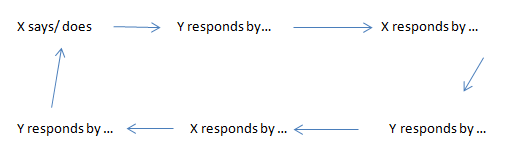
It can also be useful to track, on paper, a recurring pattern of a typical argument to externalise it, and then explore for alternative actions at each point in the argument cycle to allow it to be broken.


A useful article

There are many theories and approaches to working with couples, but an article that I have found especially useful is The multi-level approach: a road map for couple's therapy by Michele Scheinkman. It can be found in the journal Family Process Vol 47 No 2, 2008 and outlines four different levels of focus and interventions.

http://www.michelescheinkman.com/ScheinkmanMultilevelApproach2008.pdf